Wednesday, 15 May 2013

Four Cross Twelve


Name
Four Cross Twelve

Designer
Guy Brette


Manufacturer
Eric Fuller. Puzzle was from www.cubicdissection.com for US$69. Current sold out.

Type & Classification
Interlocking Burr

Dimensions
7.5 cm (Height) x 5.7 cm (Width) x 5.7 cm (Depth).

Materials & Construction
Maple and Purpleheart for the twelve pieces. Quality of construction, fit and finish is excellent. In fact the tolerances on my copy were so tight that after a few days left untouched in the room, a couple of the pieces were of a much tighter fit than what I would have liked. But a day in my camera dry box and everything was back to normal.

Overview
This puzzle allowed me to properly learn Burr Tools for the first time. For this I wish to thank puzzle designer Goh Pit Khiam for his help in teaching me how to use the software. I spent the good part of an afternoon at Goh's home not only looking at the over two hundred or so puzzles in his collection (many which are burrs and packing puzzles; and a number of which are his own designs) but also managed to sit down with him to having hands-on practice on how to define and form the pieces and use the programme solver.

One of Goh Pit Khiam's several puzzle cabinets.
This one above has door seals and an internal
heating rod to reduce humidity to prevent puzzle lock-ups
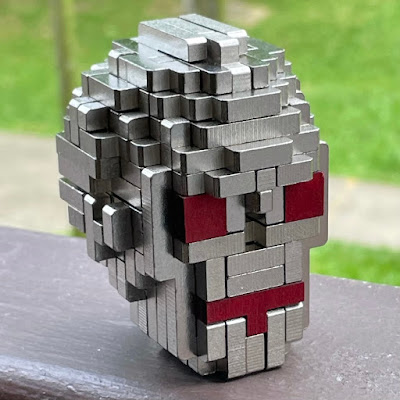
Left on my own, I would never have been able to figure out how to assemble the pieces together (yes, Eric shipped them unassembled). I used the photo of the Four Cross Twelve on his website to try to figure out things. But since I am so bad at this type of burr puzzles, as usual I got nowhere and patience is not exactly my forte.

Difficulty Level
Extremely! According to Eric, he says its "also quite difficult with a whopping level 9.9.9 solution. I'd call it the crown jewel of this update in terms of difficulty and appearance."  It takes nine moves to remove the first piece! Burrtools indicates there are 96 solutions to the Four Cross Twelve.

Summary
Hmm...having now learnt BurrTools, I am considering looking for the more interesting and rare interlocking burrs to acquire. Until recently (with my rather excessive horde of Pelikan made puzzles), I have hardly collected many burrs, packing or similar sort puzzles. But I think all that is set to change. While I am very unlikely to be able to solve any decent burr on my own, I am more than happy with the thrill I get taking apart and putting together one following the animated movements of this wonderful computer programme.

Wednesday, 8 May 2013

4 Street Elbows


Name
4 Street Elbows

Designer
Saul Bobroff


Manufacturer
Saul Bobroff. Puzzle available commercially from Eureka Puzzles for US$85.

Type & Classification
Impossible Object

Dimensions
6.2 cm (Length) x 6.2 cm (Width) x 2.2 cm (Height).

Materials & Construction
All four pieces of plumbing street elbows made of iron. Quality of construction is very good and the puzzle is coated with a sealant to prevent rusting. Wooden display stand included.

IPP
The 4 Street Elbows was Saul Bobroff's Exchange Puzzle during IPP28 held in Prague, Czech Republic in August 2008.

References
See http://www.puzzle-place.com/wiki/Impossible_Street_Elbows

Overview
The 4 Street Elbows is in reality an "impossible object". I had come by this "puzzle" through a puzzle exchange with Saul; my Ball In Cylinder No.1 for his Street Elbows. Consisting of four standard looking plumbing elbows, they are joined (and held together) by the screw threads of each elbow. Meaning to say that the pieces have not been joined by welding, glueing, force-fitting etc. When it first arrived, I was wondering how to solve it and whether in fact it was meant to be solved.

Like all impossible objects, it looks unsolvable. I did a check with Saul and he informed me that the puzzle is "solved already". I took it to mean that its really not meant to be solved in any way. Personally I am not sure if I want to try to dis-assemble it...it looks like some heavy duty tool might be needed for this task but I won't take the risk. I might just break something in the process.

Difficulty Level
Saul also mentioned that there is only one person who has removed and the elbows and put everything back into the solved state. Now I wonder who that person might be?

Summary
Not a puzzle for solving by any means, but something to be admired for its uniqueness and physical incredibility. Definitely worth collecting though.

Also by Saul Bobroff - "Too-Tite"...Impossible Object. Tennis ball in a bottle.
A gift from Saul, thank you very much.


Saturday, 20 April 2013

Tern Key


Name
Tern Key

Designer
Goh Pit Khiam


Manufacturer
Sold by Eric Fuller's Cubicdissection in 2009 for $49. Currently not available. New batch of Tern Keys expected to be released in the coming months.

Type & Classification
Sequential movement and take-apart.

Dimensions
14cm (Length) 9.6cm (Width) x 1.3cm (Height).

Materials & Construction
Acrylic, white nylon and stainless steel. The unit that is featured in this review is an initial production copy given by Eric to Goh, which will lead to a fresh batch that he will be making for release sometime soon. Construction fit and finish is excellent as per the usual Eric Fuller standards. The preision laser cutting has been carried out to very exacting tolerances. The sliding pieces all move smoothly although occasionally a piece may get a bit stuck but it takes just a slight tug to get things going again. Overall you have the look and feel of a high quality expensive puzzle.

Overview
Tern Key was another puzzle that was loaned to me by fellow Singaporean and puzzle designer Goh Pit Khiam who to-date has designed around sixty puzzles, many of which have been produced and are now in the hands of puzzlers and collectors worldwide.

The Tern Key is similar to the La Cerradura Doble by Robrecht Louage reviewed earlier in this blog, but both have different methods of solving.

The Tern Key is also a "harder" version of Goh's earlier wooden Key Puzzle (Eric will also likely be releasing the Key Puzzle in acrylic format together with the Tern Key). As Eric described during the first release of this puzzle... "The original Key Puzzle used a binary locking mechanism. Tern Key ups the ante with a trinary implementation, yielding a hefty 134 move solution with four locks!...."


I have never played with the earlier Key Puzzle so I jumped straight into the deeper end with the Tern Key. The object of the Tern Key is to slide the U-shaped key out the right side of the puzzle. The key is locked in place by four "locks" formed by sliders. One has to manoeuvre the sliders of each of the locks left, right, up and/or down to unblock and release the key. The locks cannot be worked on individually one at a time as the movement of sliders of one lock will either restrict or allow the movement of the sliders of an adjacent lock.

Given the interplay of the sliders and locks, one is required to think a number of steps ahead during the solving process. There were several times I found myself almost at the finish, only to be blocked by the last lock and I have to retrace my steps back to the beginning and start over again.

Although there are 134 steps needed to extract the key, a number of these are repetitive. Whether I really made 134 moves I honestly wouldn't know. My main aim was just to get the key out!

Difficulty Level
Very challenging but not unduly difficult. Took me the better part of a couple of hours to remove the key.

Summary
A very enjoyable puzzle and I had great fun with it. You can see clearly all that is happening through the transparent acrylic as you go about the solving process. You get a sense of achievement as you pass each lock and then that a-ha moment when you finally free the U-shaped key. Definitely worth acquiring both from the quality standpoint and puzzling perspective.

Friday, 19 April 2013

a-ha! Straight Arrow / Rectangular Jam


Name
a-ha! Straight Arrow (also known as Rectangular Jam)

Designer
Hirokazu Iwasawa


Manufacturer
ThinkFun. Puzzle cost $4.99. Also available from Amazon at $6.83. The wooden version (known as Rectangular Jam) costs 19.15EUR from Finnish online puzzle retailer Sloyd.

Type & Classification
Sliding puzzle

Dimensions
8.2cm (Length) 8.2cm (Width) x 2.5cm (Height).

Materials & Construction
Entire puzzle and pieces are made of sturdy plastic, could be ABS resin. Well made, solid and durable.

IPP
The Rectangular Jam was Hirokazu Iwasawa's puzzle design competition entry at IPP25 in Helsinki, Finland in 2005. It won the Judges' Honourable Mention. Iwasawa, who has also won several awards at various IPPs for his designs, is the man behind the AlCyl (Blue Cylinder) and Tritalon, both reviewed earlier in this blog.


Overview
This puzzle was loaned to me by fellow Singaporean and prolific puzzle designer Goh Pit Khiam whom I had the pleasure of meeting and having dinner with a couple days ago.

While it looks small and simple with only four pieces in a tray, this is quite a devious little creature. The object is to slide the green arrow out of the slot on the side of the tray without lifting the arrow or any of the rectangular pieces off the tray. Given the size of the pieces and their positions in the tray, it looks to be physically impossible. When I first played with it, I thought it was impossible too.

But obviously there is a solution and I might add a rather elegant (in Goh's words) and simple one really. Nice trick to it. Once you have figured the necessary moves, you can solve the puzzle in about under 20 seconds.

Difficulty Level
Challenging but not too difficult. Something that is likely to take minutes (or perhaps hours) to solve rather than days.... which is the type I like.

Summary
A good quality and fun pocket-sized puzzle. In plastic, it is very good value for money also.

Saturday, 13 April 2013

Burrs Galore!

Due to work and other personal commitments, I have not played with or reviewed any puzzles for a while. But during the last several weeks, a number of new wooden burr puzzles arrived, the latest batch from Jakub and Jaroslav Dvorak of Pelikan and Eric Fuller's Cubicdissection.


Clockwise from top left: Unassembled Vectes/Ghidorah (Yavuz Demirhan/Alfons Eyckmans),
Triaxe (Stephane Chomine), Estergon 2 (Yavuz Demirhan),
Columnata 2P3C (Yavuz Demirhan), Cockpit (Osanori Yamamoto),
Ice Pillar (Osanori Yamamoto), unassembled Four Cross Twelve (Guy Brette),
Derek's Half Dozen (Derek Bosch), Centre: unassembled 2-In-1 (Oskar Van Deventer)
Now what was I thinking when I ordered so many puzzles, I am now wondering to myself. Well, for one, I was attracted by some of the very colourful woods used, for example, Eric Fuller's 2-In-1 which uses 12 species of exotic hardwoods. Another reason being I wanted to have a bit more hands-on play with burrs, since I don't own many of them (and absolutely lousy with burrs!)....hmm, but now I am not so sure after looking at this complicated stash.

Virtually all of these are "super expert" level and "many-many-moves-before-the-first piece-can-be-removed" type burrs and interlocking puzzles. I am not even sure which one of these wooden beauties to start with. I still have a backlog of other puzzles which I have yet to touch beyond their unwrapping. If anyone has any suggestions, please feel free to comment.

I think I have bitten off a lot lot more than I can chew. But knowing myself, I would not unduly labour and lose sleep over a puzzle beyond a certain amount of time. I will still enjoy the exploration process of trying to it take apart and re-assembly even if I can't solve the damn thing. So we'll see how it goes with this lot of ten in the weeks, months (or years) to come.

Sunday, 24 March 2013

Twin Box Pentominoes


Name
Twin Box Pentominoes

Designer
Primitivo F. Ramos. He also designed the Pack The Podium puzzle, featured on Puzzle Place.


Manufacturer
Brian Menold. Online retail shop Wood Wonders. Special limited edition of four copies each priced at US$58. Currently unavailable.

Type & Classification
Pentominoes 3D Packing Puzzle

Dimensions
8.7cm (Length) 8.7x cm (Width) x 6.9cm (Height).

Materials & Construction
The outer box frame sides are made from Paduak while the corners are English Sycamore. The pentominoes are Yellowheart. Construction fit and finish is excellent. The pentominoes fit well and slide smoothly. But because the tolerances are very tight, this puzzle may "lock up" in very humid conditions, as did mine. But half a day or so in a camera dry box solved the problem.

Overview
Twin Pentominoes is my second puzzle from Brian Menold. The first is Stacks Of Sticks reviewed earlier in this blog. A very attractive and aesthetically pleasing puzzle. The choice of exotic hard woods creates a very nice colourful contrast, particularly the orange Paduak frame and the Yellowheart pentominoes. Probably this was what attracted me to this puzzle in the first place. Brian made a short run of four copies, each with a combination of different woods but I think this version is perhaps the most striking. This is a fairly large puzzle and feels quite a handful in the palm.

The object is to remove the pentominoes from the frame and reassemble them within. I had read from fellow puzzle blogger Kevin Sadler's blog review that the Twin Box is a very difficult packing puzzle and even he couldn't solve it without help. And so I found out the same for myself as I started to remove each piece. After the first several pieces, I knew straight away I would have a lot of trouble getting them back into the frame later. I was already getting confused by the different orientations of the box as I slid the pieces around and then out of the confines of the box.  Some pieces even had to be moved two together at the same time to be extracted.

Numbering the pieces but still of little use at the end
I decided to mark and number each piece. I even took photos and notes of how each piece slid out on my iPad, hoping this will allow for easier assembly later. But as I discovered later, I had missed a step or two during the numbering, and well...everything came out and was in a mess. All my efforts to document the disassembly for future assembly had been futile.

Re-assembly proved virtually impossible for me. Each time I could get no more than four to five pentominoes into the box before getting stuck. Finally I sought the help of Kevin and he immediately obliged by sending over the solution he obtained using Burr Tools. There is a staggering 11,821 solutions! Difficult to imagine that with thousands of solutions, the puzzle is still so difficult. With the help of the programme, I eventually got the pieces back into the frame in the right sequence...Whew! Using Burr Tools, I also found some solutions which are easier to execute than others.

Difficulty Level
Just two words....extremely difficult!

Summary
A really very nice and well-made puzzle. The colours catch everyone's attention. For the workmanship that went into it, very good value for money too. And if you want a really gruelling and ultra challenging puzzling experience (and sleepless nights), the Twin Box will also not disappoint!

Wednesday, 13 March 2013

A Drive Down Lombard Street


Name
A Drive Down Lombard Street

Designer
Brian Young


Manufacturer
Brian Young. Puzzle directly available from him via his website Mr Puzzle Australia priced at A$70/-

Type & Classification
Dexterity & Sliding

Dimensions
14.4cm (Length) x 7.6cm (Width) x 3.7cm (Height).

Materials & Construction
The box is made of Papua New Guinean Rosewood, six sliding tiles made from Western Australia Jarrah, acrylic and steel. Construction fit and finish is to a very high standard. The tiles fit well and slide smoothly. There is enough "gap" between the tiles so humidity would not be an issue for this puzzle.

IPP
The Drive Down Lombard Street was Brian's Exchange Puzzle during IPP29 in San Francisco, USA in August 2009. Like most of Brian's exchange puzzles, this one is a themed puzzle inspired by the popular tourist attraction, Lombard Street in San Francisco, which is the world's most crookedest street.

Overview
The object of the puzzle is to "take a drive down Lombard Street"; manoeuvring a ball bearing from tile to tile at the starting point on top, ie Hyde Street down to the bottom end point, Leavensworth Street. Each of the six tiles have grooves and notches cut into them to allow the ball bearing to roll atop each tile and to move from one to the next. All the six tiles are also able to move or slide, similar to a regular sliding puzzle. The tiles are covered by acrylic so you cannot physically touch them but must use dexterity in order to move them around within the confines of the box.

Solving the puzzle requires one not only the use dexterity to move the ball bearing from tile to tile, but also  the tiles need to be in the correct orientation to enable the grooves to be aligned properly for the ball bearing to roll from one tile to the next. Basically slide/move the tiles to form a maze with the grooves and navigate the ball bearing through the maze. To make things even harder, the grooves on each tile are cut differently so forming the maze is not that simple.

And because there is a one empty space to allow the tiles to slide, the ball bearing can quite easily fall off a tile (if one is not careful during the sliding  process) to the bottom of the box. I think Brian also deliberately made the grooves shallow enough to allow this to happen to make the puzzle harder. Here you have to reposition the ball bearing on the starting point again and begin all over.

Difficulty Level
The puzzle provides a fair amount of challenge but is not very difficult. Yes, it requires dexterity and some thinking to get the tiles in the right positions. I took about twenty minutes to get from start to finish, with several falls and re-starts in between. After a while you will get the hang of it and you can quite easily prevent the ball bearing from dropping over the side as you move the tiles around.

Brian states that the "ultimate solution" is one with the least dexterity required; with minimal tile movement. I am not sure if I solved it with less or more steps than what he intended as I was just focused on getting the ball bearing to the end point. But his solution sheet requires a minimum of fourteen steps, and this is only after certain tiles are already in the right starting position.

Summary
The Drive Down Lombard Street provides a nice and different twist to the usual sliding puzzle genre in that there is also a dexterity element thrown in. It doesn't take too long to solve. But more importantly, I think its a pretty fun puzzle to spend time with.
Related Posts Plugin for WordPress, Blogger...